article
Weinreb on the Shepherd Within
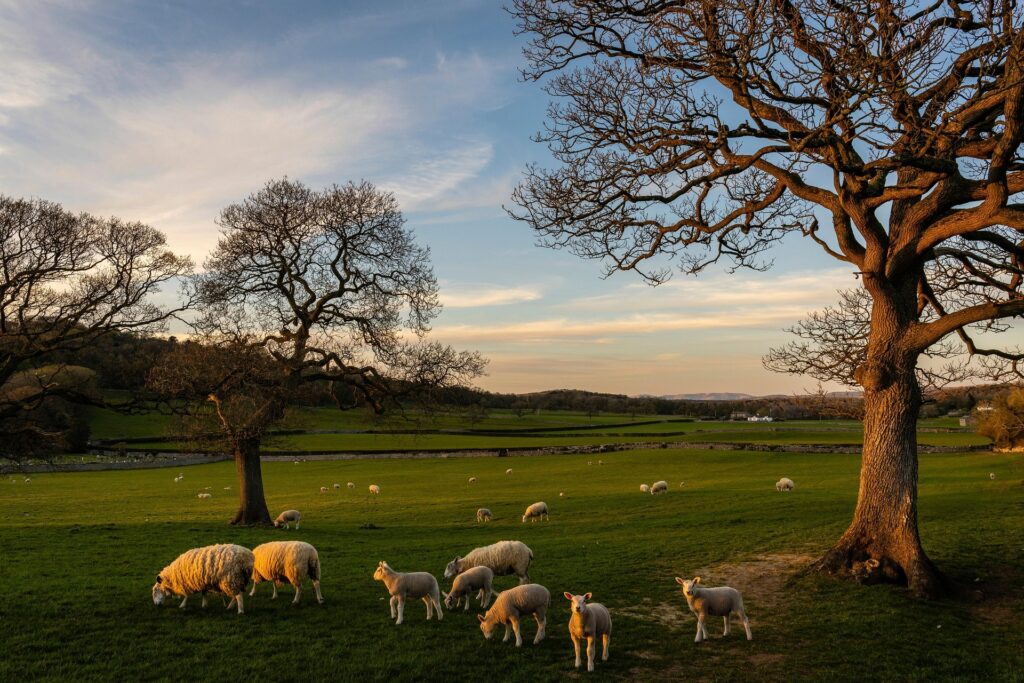
Hello, dear friends, happy to write to you with the picture of the herd.
The amorphous movement of the flock, reminded me of the verse: “For every shepherd is an abomination unto the Egyptians.” This is how Joseph explains to his brothers why they will be able to settle in the land of Goshen, and not in Egypt proper.
Symbolically, Egypt represents the rule of the rigid, lawful establishment — the registry, the recording and the surveillance, the formal ceremony; everything that is cast and set within a fixed form. Goshen, by contrast, is a kind of marginal space or borderland where the children of Israel can dwell.
Flocks moving through open space raise clouds of dust, scattering and gathering, with no fixed shape. They don’t settle into a predetermined order. One can be with them, walk with them, move with them. And this mode of being is intolerable to Egypt.
For Friedrich Weinreb, when Egypt is spoken of, it isn’t only a historical place, but also an inner state within a person. Within the person, Egypt is the part that seeks to turn life into something known, ordered, and controlled. It’s the part that wants clear definitions, laws, order, roles, names and numbers.
The sheep, by contrast, symbolize for Weinreb another layer of the person: walking, attentiveness, movement that doesn’t arise only from plan or law. It’s no accident that the shepherds — Abraham, Isaac, Jacob, Moses, and David — are foundational figures. The shepherd doesn’t impose form; he moves with the movement, attentive to it.
So the verse can also be read this way: “for every shepherd is an abomination unto the Egyptians” — within a person there is an “Egyptian” part that struggles to accept what cannot be measured, recorded, and controlled. It fears the spontaneous, the living, the cloud, the dust, the path that isn’t marked out in advance. Meanwhile the “shepherd” within the person is willing to dwell in not-knowing, to walk with life, to listen rather than only manage.
Returning to the image from the Ruhama badlands: the dust rising from the flock obscures the clear shape. Inwardly, this is the moment when a person doesn’t rely only on definitions and roles, but meets being itself — something living, moving, and changing.
Perhaps this is why, for Weinreb, the exodus from Egypt is not only a departure from a place, but an inner passage: a passage from a life built only on form and control, to a life that also holds walking, trust, and attentiveness to what moves within the person and beyond them.

Loading comments...