article
Inside the Aquarium: The Beatles and the Embalmed World
There is something extraordinary about watching the Beatles perform at the Washington Coliseum in February 1964, and then watching them again, five years later, on the rooftop of the Apple building in London.Only five years separate these two performances. And yet, they seem to belong to two entirely different eras.
1. Two Performances, Two Worlds
In Washington, the four young men wear elegant grey suits with black velvet collars, narrow trousers, and high-heeled boots. Their appearance is remarkably simple, almost understated. They are dressed with care, but there is something entirely unrestrained about the way they move. They sing, laugh, turn toward one another, and inhabit their music with a natural freedom.
Around them, however, there seems to be another world.
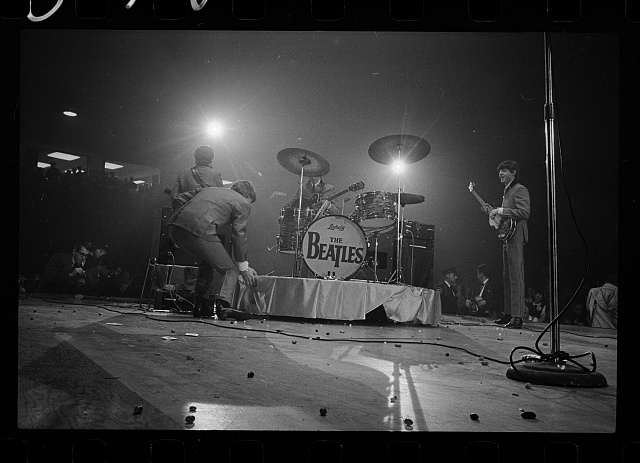
Creator(s): Trikosko, Marion S., photographer. 1964, Library of Congress
The people watching them appear almost enclosed within their own image. Their clothes, their posture, their expressions belong to a world of conventions and carefully maintained appearances. They seem to be sitting inside a framed photograph, while the Beatles move freely within the same room.
And then, five years later, the same encounter takes place again.On January 30, 1969, the Beatles perform on the rooftop of the Apple building in London. Below them is the ordinary city: offices, streets, people going about their working day. Men in suits stop and look up. Policemen arrive. People gather around the building. The performance interrupts the ordinary order of things.The Beatles seem to belong to a different time, although they are standing in precisely the same time and place as everyone else.
They are not necessarily younger, nor are they untouched by the changes of the preceding years. They have changed enormously. Yet they appear alive in a way that makes the surrounding world seem strangely preserved, almost embalmed. What interests me is not primarily their music, their artistic achievement, or even the four personalities who made up the band. What interests me is the world they encountered. What kind of world was it that needed to be awakened by their singing?
Perhaps the Beatles are best understood not only through what they brought into the world, but through what their presence revealed about the world that received them.
2. The Sleeping World
It is almost like the story of Sleeping Beauty. The princess is not dead. Life is still there, but it has fallen into a profound sleep. The kiss does not create life; it awakens what was already alive. Something similar seems to happen in these performances. The Beatles do not manufacture vitality in their audience. They encounter people who, for a moment, seem to discover that they too are capable of moving, responding, laughing, and being surprised by their own existence.One can almost imagine the unspoken question passing through the faces of the people watching:
Am I alive too? Is this possible for me?
This is what makes the images so compelling. The audience is not simply watching a musical performance. It is witnessing a possibility of existence that seems to have become unfamiliar.The world around the Beatles is not necessarily a world without pleasure, intelligence, beauty, or feeling. It is a world of established forms: work, status, manners, clothing, institutions, schedules, and social roles. A world that knows how to organize itself, how to present itself, and how to maintain its appearance. But perhaps, somewhere along the way, the forms have begun to replace the life they were meant to contain.
The Beatles enter this world not as reformers or teachers. They do not deliver a lecture about freedom. They simply sing. Their bodies move with the music. They look at one another. They laugh. Their presence seems to carry an entirely different relationship with being alive.
3. Four Messengers
And perhaps this is why the image of the four angels comes to mind. In the sacred texts, angels are messengers. They enter the human world carrying something that does not originate in its ordinary order. Their appearance brings news, but sometimes the news is not a sentence or an instruction. It is the very presence of another possibility.
The Beatles, in these images, seem almost like four messengers. They inhabit the same historical moment as the people around them, yet they carry a different spirit. The people in Washington in 1964 and the people on the streets of London in 1969 are not living in another century. They share the same buildings, the same streets, the same weather, the same calendar. And yet, visually, they seem to belong to different worlds. The Beatles are not outside the aquarium. They are inside it, too. But somehow they breathe differently.
4. The Life Behind the Appearances
And perhaps the most moving part of the encounter is that the supposedly sleeping world begins to respond. People stop what they are doing. They look up. They listen. Something moves behind the familiar appearances. The Beatles did not simply give the world new songs. They revealed something about the world that was waiting to hear them. Perhaps their real significance lies in this encounter: not only in the music they made, but in the life that became visible around them.
The question, then, is not simply why the Beatles changed the world. It is this:
What kind of world needs to be awakened by a song?
Loading comments...