bible
Remembering By Forgetting
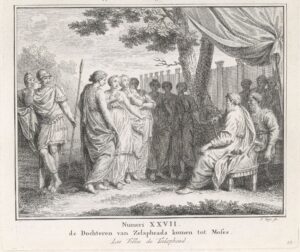
In Sefer BaMidbar (Numbers) we read about the daughters of Zlofhad. They come to Moses and say: “Why should the name of our father disappear from his family because he had no sons? Give us property among our father’s brothers.”
The story is simple. The father Zlofhad died, but he had no son to remember him. In Hebrew the word zachar means male, from the verb “to remember” — zocher — remembering the Source.
Now Zlofhad, which means “shadow-fear,” had only daughters, who symbolize appearance in time, and no son to remember the Source.
Zlofhad comes from the tribe of Menashe, who is the firstborn of Joseph in Egypt. When he was born, Joseph said: “God has made me forget my toil” — nashani Elohim — and he named him Menashe. Menashe comes from neshiya, which means forgetfulness. Neshiya in Hebrew — nun-shin-yod-heh — is close to nashim (women), since women symbolize appearance in time, in the manifestation. And in time, as everything moves, there is a danger of being carried away from the river (nahal נחל) — this is why they want nahala נחל-ה to hook the brook of life, the river, into their daily living in the land.
The value of women in Hebrew — nun-shin-yod-mem — is 400, the full manifestation: like the 400 shekels that Abraham paid for the Machpela; like the name Efron, the man he bought the place from; like the 400 years his seed was promised to dwell in a foreign land. And nashim shares the same letters as shanim — years — the movement of the current away from the Source.
It is the daughters of forgetfulness (bnot Menashe) who want to remember — by keeping the customs of their ancestors. In this way, memory (zikaron) can be lived through the customs, on the land of the place. In this way they can remember, zocher, the Source.
The whole totality of manifestation is 400. There are 5 daughters: 400 × 5 = 2000. The space of the Shabbat boundary (tehum Shabbat) is 2000 amma (cubits) — beyond this, a man loses himself in time. And as the commandment says: “Remember the seventh day to sanctify it” — Zachor et yom haShabbat lekadsho.
Now Zlofhad was gathering (Mekoshesh) wood on the seventh day. According to the book of Zohar, he was checking if the infinite, Tree of Life, could be measured within the finite vessels of the Tree of Knowledge. Because, having daughters, he was measuring life in time and forgot (nasha) the seventh day.
This is where the wondrous correction (Tikun) of his daughters, comes into play: The daughters of Zlofhad realized that their father had mistaken in his ‘measurement.’ He believed that he had no continuity because he lacked a male heir—a Zachar (son/memory) from the Tree of Life. They stepped forward to show that even through the way of Nashim (women/400—the world of measurement and time), one can reach the 2,000-cubit Sabbath boundary of the Tree of Life.



Loading comments...